• Dvir Gallery is delighted to announce Simon Fujiwara’s solo exhibition at MUDAM – The Contemporary Art Museum of Luxembourg.
     
  • SIMON FUJIWARA

    SIMON FUJIWARA

    Simon Fujiwara born 1982, London, England. Lives and works in Berlin, Germany.
     
    Fujiwara’s work takes multiple forms including wax figures, robotic cameras, ‘make-up’ paintings and short films that address the complexity and contradictions of identity in a post-internet, hyper-capitalist world. In 2022, Simon Fujiwara introduced to the world ‘Who the Bær,’ an original cartoon character that inhabits a fantasy universe created by the artist and infiltrates various art-world images and masterpieces from art history. Part of the series premiered at the Prada Foundation.
     
    Fujiwara had numerous solo exhibitions, among others, at KIAMSA (Helsinki), the Fondazione Prada (Milano), Blaffer Art Museum (Houston, TX), Kunsthalle Düsseldorf (Düsseldorf), Tokyo Opera City Art Gallery (Tokyo). He was part of various group exhibitions, including in the MAXXI (Rome), Solomon R. Guggenheim Museum (New York City), Musée national d’Art Moderne — Centre Georges Pompidou (Paris), Hamburger Bahnhof (Berlin). Fujiwara has been shortlisted for the Preis der Nationalgalerie at Hamburger Bahnhof. His works are part of numerous prestigious collections including The Tate Collection, London; MoMa, New York; Solomon R. Guggenheim Museum, New York; Sammlung Verbund, Vienna; The Israel Museum, Jerusalem; Galeries Lafayette, Paris; The Prada Collection, Milan amongst others.
  • WHO THE BÆR (2022 - ONGOING)

    Simon Fujiwara, Who are the flowers? (S16), 2023

    Simon Fujiwara

    Who are the flowers? (S16), 2023
    Acrylic and charcoal on canvas
    72,5 x 72,5 x 7,5 cm (framed and glazed)
    unique
  • Who the Bær is an original cartoon character created by Simon Fujiwara — a figure without a fixed identity, history, race, gender, or sexuality. Known simply as Who, this bear exists as a two-dimensional image in a flat, online world made entirely of other images. With white fur, a golden heart, and a long pink tongue, Who knows only one thing: they are an image, and their endless quest is to define themselves within an image-saturated universe. Who the Bær has the unique ability to transform into any figure, style, or symbol they encounter — human, animal, object, or icon. In this way, Who inhabits a world of absolute freedom: transcending time, place, and category, endlessly adopting new appearances. Yet at the core of this freedom lies a paradox — Who can take on any identity except one thing they may secretly long for: authenticity. But does a cartoon image even need to be authentic, or is it enough to simply perform authenticity in a world driven by appearances?


    Since its creation a few years ago, Who the Bær’s universe — the Whoniverse — has rapidly expanded, moving from initial drawings to large-scale paintings, sculptures, installations, animations, a children’s book, and even a line of merchandise under the playful label Whotique. Bridging the worlds of conceptual art, consumer culture, craft, and pop imagery, Who the Bær acts as a mirror to contemporary anxieties around identity, image culture, and hyper-consumerism. Blending lightness, humor, and sharp critique, Fujiwara’s creation is both a conceptual artwork and a brand, a fairytale character and a social commentary — reflecting the contradictions, possibilities, and absurdities of the times we live in.
     
    Who the Bær can also be followed via their official Instagram account @whothebaer.
    • Simon Fujiwara, Who is le Désespéré?, 2022
      Simon Fujiwara, Who is le Désespéré?, 2022
    • Simon Fujiwara, ceci n'est pas un une um who? (survival), 2023
      Simon Fujiwara, ceci n'est pas un une um who? (survival), 2023
  •  
     
    Simon Fujiwara
    Once Upon A Who, 2021
    Installation with stop-motion animation
    Duration: 4:48 min.
    Reference room size: 4 x 5 m (13 x 16 ft.) approx.
    Edition of 8 + 2 AP
  • FABULOUS BEASTS (2016)
     
    Simon Fujiwara
    Fabulous Beasts (Great depression mink), 2016
    dyed artificial fur on wooden stretcher
    150 x 100 x 2.3 cm, unique

    FABULOUS BEASTS (2016)

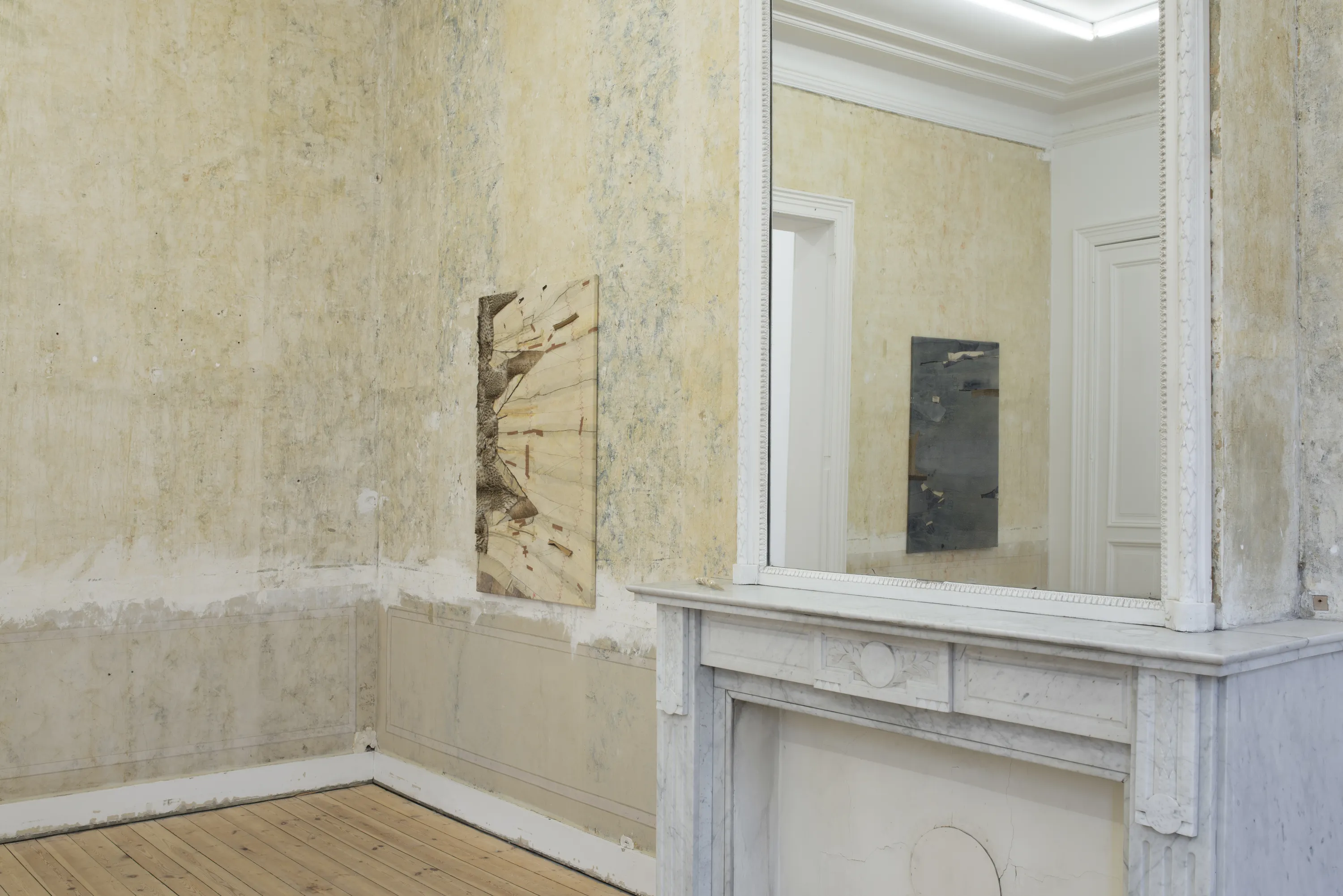
    Fabulous Beasts is a series of fur coats purchased in and around Berlin dating from 1950-2000. The coats are shaved to remove all traces of fur and to reveal the archaeology of their production including manufacturers stamps, painstaking patchwork detail, dye marks and animal skin diseases and blemishes. The coats are further deconstructed based on the tailoring pattern and reconfigured into flat skins mounted on a stretcher as tokens of a defunct idea of wealth. Reminiscent of anthropological hides and early man’s clothing the works trace the changing nature of taste, value, luxury and society. In their new state the skins appear both primal and luxurious in an age where the deeper knowledge of production history is fetishized as much as the finished products themselves.

  • Nouvelles, 2016 exhibition view, Dvir Gallery Brussels, Belgium

    Nouvelles, 2016

    exhibition view, Dvir Gallery Brussels, Belgium

  • Syphilis – A Conquest (2020)

    SS Delirium, detail, 2020

    Mixed media

    82 x 170 x 220 cm


    Installation view: It’s a Small World, Museum of Contemporary Art Kiasma, Helsinki, 2024

    Courtesy of Kiasma, Museum of Contemporary Art

    Photo: © Andrea Rossetti

    Syphilis – A Conquest (2020)

    Syphilis – A Conquest (2019–) charts Fujiwara’s experience of contracting and recovering from syphilis, staging the journey as an adventure tale and mining the illness’s art historical resonance. 
  • Masks (Merkel) (2015)

    Simon Fujiwara, Masks (Merkel), 2015

    Simon Fujiwara

    Masks (Merkel), 2015
    make-up, linen, wood
    62.5 x 105.4 x 4.5 cm (each)
    62.5 x 210.8 x 4.5 cm (total)
    unique
  • ‘Masks’ is a series of over 150 unique abstract paintings that together form a monumental, multi-part, mosaic portrait of the German leader Angela Merkel’s face. Measuring a total of 18 x 24 meters - as if zooming in over 1000 times into her actual face - the fragmented portrait is painted with the same make up used by the world’s most powerful woman on a daily basis. Produced in collaboration with Merkel’s personal make-up artist in Berlin, each portrait charts not only the colours and materials but also the application techniques of the chancellor’s face, creating a factual document of a historic figure that belies its abstract and expressive appearance. The ethereal images evoke a modern day ‘Turin Shroud’. Only decipherable as skin from a distance of some meters, the image disappears as the viewer approaches the canvas. ‘Masks’ is a visual translation of ‘The Emperor’s New Clothes’ story, a parable of power held in the eye of the beholder. Since all world leaders including Mrs. Merkel wear HD make-up - make-up produced especially for high definition cameras - the works masks cannot be photographed as the material itself is designed to disappear - denying the camera its omnipotence in today’s media landscape - and leaving only our biological faculties of sight and smell to experience the works.
    • Simon Fujiwara, Masks (Merkel), 2015

      Simon Fujiwara

      Masks (Merkel), 2015
      make-up, linen, wood
      120 x 200 x 5 cm
      unique
    • Simon Fujiwara, Masks (Merkel), 2017

      Simon Fujiwara

      Masks (Merkel), 2017
      make-up, linen, wood
      196 x 116 x 5 cm
      unique
  • THE HOPE HOUSE (2017) For his third exhibition at Dvir Gallery, Simon Fujiwara presented ‘Hope House’, an immersive large-scale exhibition...
    Simon Fujiwara
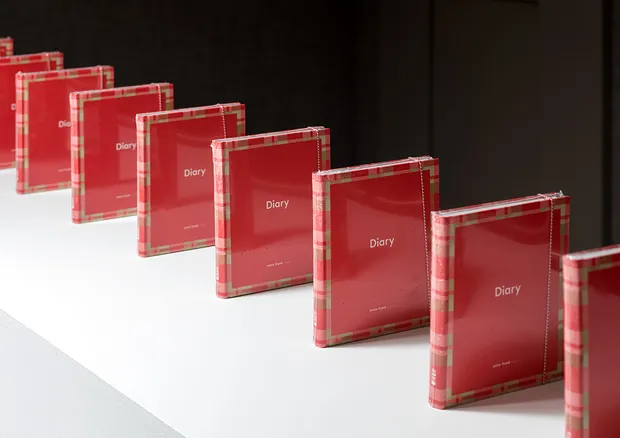
    Diary, detail, 2017
    18 x 15.5 x 2 cm
    plinth of 10 diaries, edition of 3

    THE HOPE HOUSE (2017)

     
    For his third exhibition at Dvir Gallery, Simon Fujiwara presented ‘Hope House’, an immersive large-scale exhibition centering on a full-scale replica of the Anne Frank House. During a visit to the Anne Frank House Museum in Amsterdam, Fujiwara purchased a 1:60 scale model of the building from the gift store, intended as merchandise for visitors to build themselves. For this exhibition, Fujiwara took the model as source material for a full scale, 1:1 architectural replica of the house constructed within the gallery and split across three floors of the building.
    Imagined as a ‘building within a building’, Hope House features several of the spaces key to the Anne Frank narrative including the secret annex and attic described in her diary. In this regard, Hope House is neither a museum nor a simple facsimile of the Anne Frank house but a hybrid experience whose origins as a model/product speak of the increasing synthesis of ideology, politics, philanthropy and capitalism. Residing within the spaces of Hope House visitors encounter numerous sculptures, artifacts, domestic interiors, video works and sound installations that together create a Gesamtkunstwerk as well as a material investigation into the ways hope, positivity, empathy and ‘doing good’ perform under the hyper-capitalist ideology of the 21st century. 


  • Simon Fujiwara, Likeness, 2018